Boxy's Travels - A lunchbox's global supply chain journey from Factory to Your Local Store
19-Sep-2025 - SCM4ALL Team
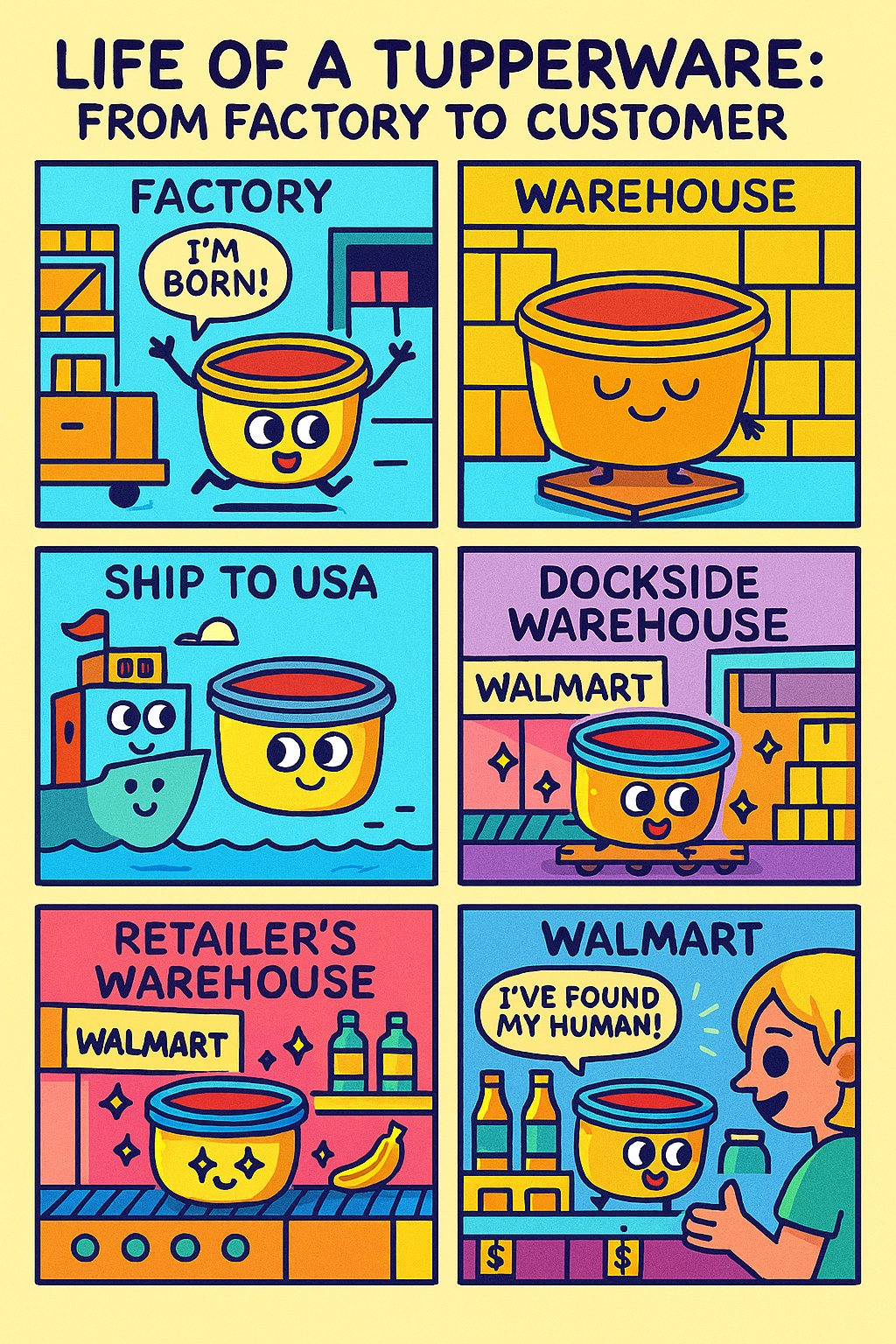
Hello, world—or should I say, hello, endless aisles of retail glory? My name is Boxy, and I'm no ordinary plastic container. I'm a freshly minted Tupperware-style storage box, complete with airtight seals, stackable design, and a faint whiff of industrial efficiency. Just moments ago, I blinked into existence on the humming assembly line of an offshore factory in Shenzhen, China. The roar of injection molding machines, the click-clack of robotic arms sealing my lid—it's all a blur. But now, as the first rays of awareness hit my translucent blue walls, I find myself pondering the grand adventure ahead: How does a humble box like me navigate the labyrinthine world of supply chain management (SCM) to end up on a Walmart shelf, ready to organize someone's chaotic sock drawer?
In this blog post, I'll narrate my journey from a third-person observer's lens—think of me as a wide-eyed stowaway in my own cargo hold. We'll dive deep into the SCM intricacies: the warehouse wizardry at every stop, the digital and paper trails that keep me legal and traceable, the contractual handshakes between manufacturers, importers, distributors, and retailers, and the high-stakes scramble to meet seasonal surges like the back-to-school frenzy. As a hot-selling item amid the August rush for lunchbox essentials, my path is anything but leisurely. Buckle up (or seal your lid tight)—this is the story of how global trade turns raw ambition into retail reality.
Awakening in the Factory: The Spark of Production and Initial Paperwork
Picture this: It's a sweltering July morning in Shenzhen. The factory floor buzzes like a beehive on steroids—conveyor belts snake through the air, workers in hairnets dart between stations, and quality inspectors wield barcode scanners like lightsabers. I'm extruded from food-grade polypropylene, molded, cooled, and tested for leaks in under 60 seconds. But SCM doesn't start with my birth; it begins with the Purchase Order (PO) that kicked off my production run.
The retailer consortium—Walmart, Kroger, Costco—doesn't deal directly with factories like mine. Enter the third-party trading company, let's call them Global Traders Inc. (GTI), a savvy importer/distributor based in Hong Kong. Months earlier, GTI issued a PO to the manufacturer via an electronic data interchange (EDI) system, a digital handshake specifying 500,000 units at $1.50 each, with delivery FOB (Free on Board) Shenzhen by August 15. This PO is sacred in SCM: it's the binding commitment that triggers raw material sourcing (polypropylene pellets from upstream suppliers) and production scheduling. Without it, I'd still be a blueprint.
As I tumble off the line into a cardboard master carton (stacked 50 high with my siblings), the factory's warehouse kicks into gear. This isn't some dusty shed—it's a high-tech facility with automated storage and retrieval systems (AS/RS) towering 40 feet, RFID tags buzzing on every pallet, and a warehouse management system (WMS) like SAP orchestrating the chaos. Warehouse processes here are lean and mean:
- Receiving (inbound from production): Finished goods are scanned into the WMS, verified against production logs for quality (e.g., no warps, seals intact), and quarantined if needed. Yield? 99.2% pass rate, thanks to inline sensors.
- Putaway: Forklifts or autonomous guided vehicles (AGVs) shuttle pallets to high-bay racking, optimized by slotting algorithms that place fast-movers (like me) near loading docks.
- Storage: Climate-controlled at 75°F to prevent warping, with cycle counts every 48 hours to catch discrepancies.
- Order picking and packing: Batches for GTI are wave-picked (grouped by destination), labeled, and stretch-wrapped. No cross-docking here—it's pure consolidation.
But I'm not out the door yet. The origin paperwork ignites:
- Packing Slip: Generated electronically via the WMS, this itemizes my carton's contents (50 units, dimensions 12x8x6 inches, net weight 15 lbs). It's clipped inside the master carton for quick verification—crucial for downstream audits, as discrepancies can halt entire shipments.
- Commercial Invoice: The manufacturer's bill to GTI, detailing value ($75,000 total), HS code (3924.10 for plastic tableware), and Incoterms (FOB). This feeds into customs valuation and duty calculations—miss it, and you're looking at delays or fines.
- Box Labels: Barcoded stickers with lot numbers, origin (China), and handling instructions ("This Side Up") slapped on every carton. They're the unsung heroes of traceability, enabling recalls if a batch fails safety tests.
- Bill of Lading (BOL): As pallets are loaded onto a container (40-foot HC, stuffed with 10,000 of us), the ocean carrier issues an electronic BOL via platforms like INTTRA. It serves triple duty: contract of carriage, receipt of goods, and document of title. Importance? Without it, the ship doesn't sail—it's the legal proof GTI owns me once loaded.
These docs aren't just bureaucracy; they're the SCM nervous system. Electronic versions (via EDI or blockchain pilots) zip to GTI's ERP system, syncing inventory visibility and triggering payments. Legally, under the manufacturer-GTI contract (more on that soon), failure to provide accurate paperwork breaches warranty clauses, risking termination.
Crossing Oceans: Ocean Freight and the Importer's Gateway
Sealed in my container—surrounded by foam peanuts and dreams of suburbia—we board the Evergreen Ever-Grace at Yantian Port. The voyage to Long Beach, California? 28 days, give or take a typhoon. SCM here is all about visibility: GPS trackers ping our location to GTI's dashboard, while the BOL travels electronically to U.S. Customs via the Automated Manifest System (AMS).
GTI, as the importer of record, shoulders the SCM heavy lifting. Their contract with the manufacturer mandates compliance with U.S. FDA regs (for food-contact plastics like me) and TSCA (Toxic Substances Control Act). Key legal/contract terms in this third-party setup? From an SCM lens:
- Mandatory Clauses: Indemnification (manufacturer covers GTI for defects), force majeure (excusing delays from strikes or pandemics), and IP protection (no knockoffs). Exclusivity? GTI gets sole import rights for North America, but non-compete limits them from private-labeling rivals.
- Payment & Risk Terms: Net 60 days post-BOL, with letters of credit securing the PO. Title transfers at FOB, but GTI assumes risk during transit—insured via cargo policies.
- Compliance Riders: Anti-dumping duties (if applicable), ethical sourcing (no Uyghur labor), and ESG reporting. Breaches trigger audits or penalties up to 10% of contract value.
Arrival at Long Beach: Customs clearance via a broker using the entry summary (CBP Form 7501), cross-checked against the commercial invoice and packing slip. Duties? 3.7% ad valorem, deferred if using a bonded warehouse. Delays here can cascade—remember the 2021 Suez snag?—so GTI buffers with air freight for 5% of hot items.
Importer's Warehouse: The Great American Sort
Off the ship, via drayage trucks (chassis to rail), I hit GTI's distribution center (DC) in Riverside, CA—a 500,000 sq ft behemoth with conveyor sorters whirring like slot machines. This is bonded warehousing at its finest: I sit duty-free until allocated to retailers, optimizing cash flow.
Warehouse processes are a symphony of automation:
- Inbound Unloading: Trucks dock; teams scan BOLs, count cartons (tally matches packing slip?), and inspect for transit damage (saltwater corrosion? Zero tolerance).
- Deconsolidation: Master cartons broken down; I'm repalletized by retailer (Walmart gets blue-box SKUs, Kroger greens).
- Quality Gate: Random sampling via AQL standards; fails go to rework bay.
- Putaway: AS/RS bins me by SKU velocity—I'm a fast-mover, so dock-proximate.
- Value-Added Services (VAS): For Walmart, GTI slaps on UPC labels and retail-ready packaging. Inventory? Real-time via WMS, with ABC analysis flagging me as A-class (high demand).
Here, the Advance Shipment Notice (ASN) shines: An EDI 856 transmission from GTI to Walmart 24 hours pre-arrival, detailing quantities, expected date, and carrier. It preps Walmart's receiving system, slashing dock-to-stock time from days to hours. Importance? ASNs reduce errors by 30%, per GS1 standards—vital for just-in-time replenishment.
Invoices follow: GTI's to Walmart post-receipt, reconciling against POs. Electronic invoicing via Ariba cuts processing from 10 days to 2.
Retailer's Realm: From DC to Store Shelf
GTI's ASN triggers Walmart's PO fulfillment. Full truckload (FTL) hauls me cross-country to Bentonville's massive DC—1.2 million sq ft, with 100+ miles of conveyor belts. Seasonal surge alert: Back-to-school is here, and storage boxes like me are gold. Demand spikes 40% in July-August, per NRF data—parents stockpiling for dorms and lunches. Stockouts? Catastrophic, costing $1B industry-wide in lost sales.
Walmart DC processes, turbocharged for seasonality:
- Cross-Docking: 70% of goods bypass storage; I'm sorted by store route in under 12 hours, minimizing holding costs.
- Case Picking: Robots like Symbotic pluck cartons, wave-sorting to trailers.
- Outbound Loading: Route-optimized via ORION software; less-than-truckload (LTL) for smaller Kroger runs.
To dodge stockouts, Walmart deploys:
- Demand Sensing: AI crunches POS data, weather, and social trends—boosting forecasts 15%. For me, it predicts 2x volume, prompting GTI for air-shipped buffers.
- Safety Stock Buffers: 20% extra for seasonal SKUs, held in forward DCs.
- Vendor-Managed Inventory (VMI): GTI monitors Walmart's levels via shared portals, auto-replenishing to prevent gaps.
- Diversification: Multi-sourcing (10% from Vietnam factories) hedges disruptions.
Legal ties? GTI-Walmart master agreement mandates OTIF (On-Time In-Full) >98%, with rebates for misses. Contracts include SLAs for ASNs and dispute arbitration.
Final Stretch: Truck to Shelf, and the Customer's Grasp
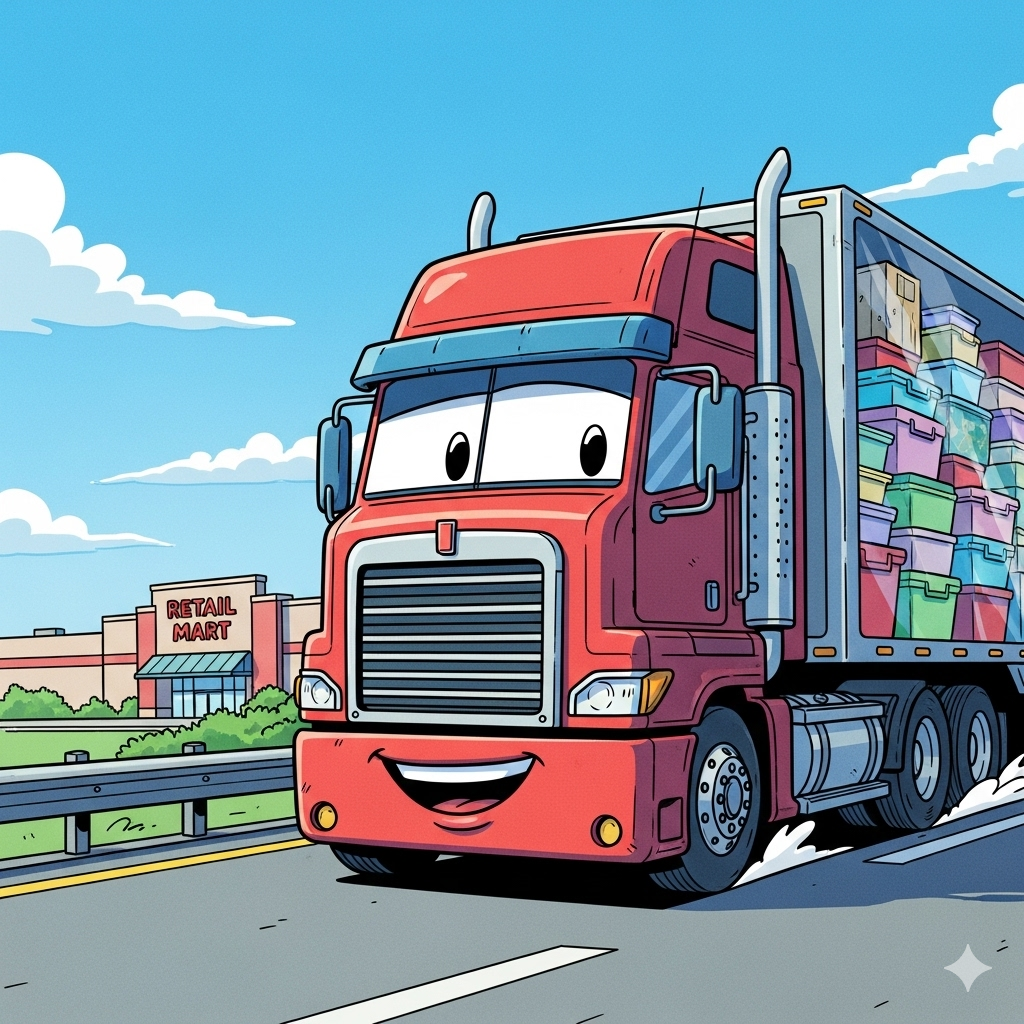
From Bentonville, store-bound trailers roll out—me destined for a Dallas Walmart. At the store DC (if any), quick putaway; then to the sales floor. Store warehouse (backroom) processes: Compact racking, daily cycle counts, and handheld scanners feeding Retail Link for real-time stock. Picking? Night crews slot me to end-cap displays, tagged with shelf life (indefinite for me, but rotated FIFO).
As a hot item, back-to-school promo pricing ($4.97) flies me off shelves. No stockouts here—Walmart's micro-fulfillment centers (in-store bots) pull from backstock in minutes.
Epilogue: Sealed with a Click

From Shenzhen spark to Walmart wow, my journey underscores SCM's magic: integrated systems turning chaos into cash flow. Paperwork like ASNs and BOLs are the glue; warehouses, the engines; contracts, the guardrails. And for seasonal sizzlers like me? It's all about foresight—demand signals, buffers, and collaboration to keep shelves stocked and customers smiling.
- Yours Storingly, Boxy
(Disclaimer: This narrative draws on standard SCM practices as of 2025; real flows vary by entity, and names used to illustrate a point, not to be mistaken for accurate description.)
What's your supply chain story? get in touch — maybe we will tell your tale next.