Caterpillar's Reman Process : An exploration
25-Sep-2025 - SCM4ALL Team
Welcome to SCM4ALL! In supply chain management, the process of recovering products after use—known as reverse logistics—is often the most complex and critical part of a sustainability strategy. For heavy equipment giants like Caterpillar, this isn't just a waste management program; it's a financial and operational necessity driven by its robust remanufacturing division. At the heart of this system is a single concept: the Core.
Part 1: What is a “Core” and Why is it Valuable?
In the remanufacturing world, a core is a used product or component that has reached the end of its service life but retains enough structural integrity to be restored to like-new condition.
Think of it as the "skeleton" of a part—an engine block, a transmission housing, or a hydraulic pump casing. Critically, cores are not scrap; they are valuable inputs for remanufacturing, making them a crucial resource in the circular economy. The concept is used across various industries, including automotive, aerospace, and industrial equipment.
Part 2: The Financial Backbone: Core Credits and the Exchange Program
The system that ensures a steady return of these valuable components is the Core Exchange Program, which is managed through the use of Core Credits.
How the System Works:
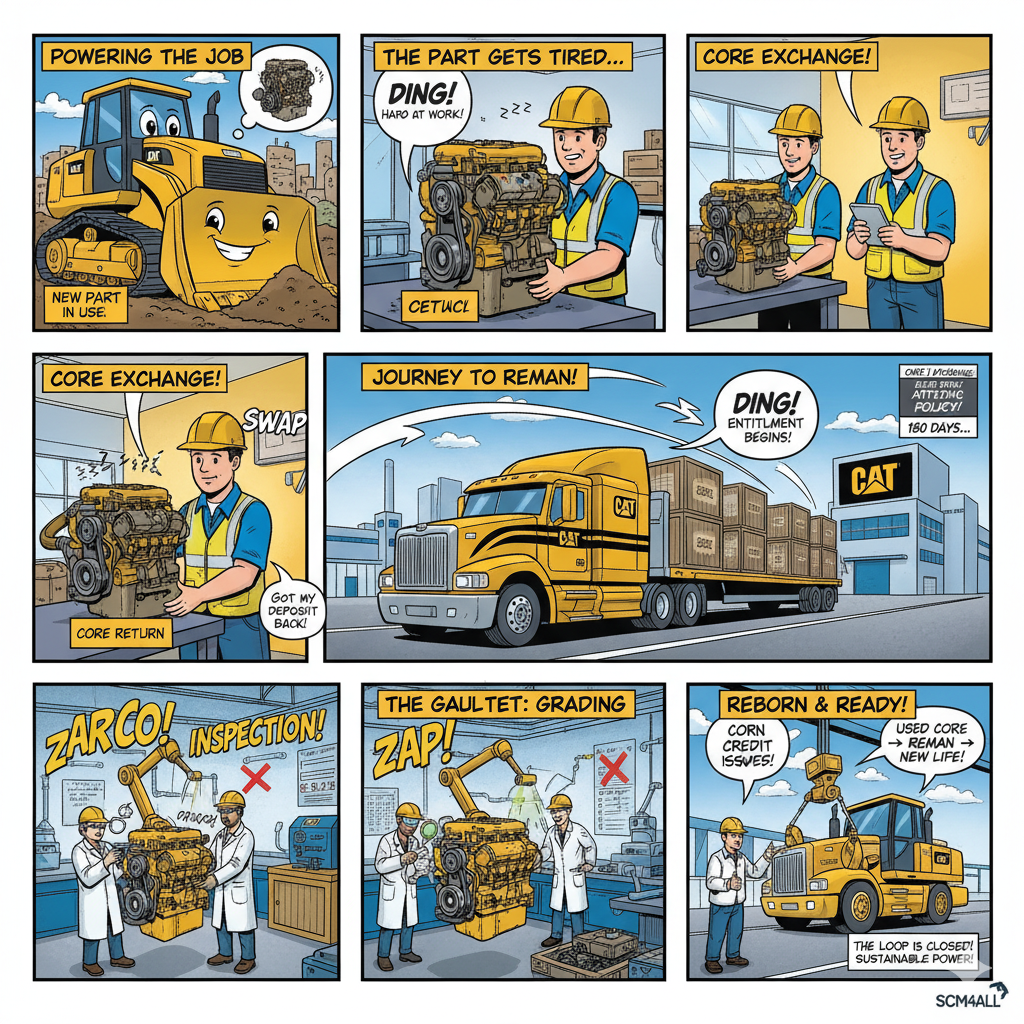
- Initial Purchase: When a customer (like a dealer or end-user) buys a remanufactured part (e.g., a reman engine) from Caterpillar, the price includes a core deposit.
- Core Deposit: This is a refundable amount that is contingent on the customer returning their used component.
- Core Return: The customer sends back the used component (the core) within a specified time frame.
- Credit Issuance: If the returned core meets the acceptance criteria (it must be complete and undamaged), Caterpillar issues a core credit. This credit either refunds the deposit or offsets future purchases.
This financial system requires tight coordination between sales, returns, and inventory management, making it a key area for learners mastering reverse logistics and remanufacturing economics.
Applying the Credit
Core credits are applied in two main ways:
- Direct Offset: When a core is returned and a reman part is purchased simultaneously, the credit is applied directly to reduce the invoice amount.
- Deferred Credit: If the core is returned *after* the purchase, a credit memo or refund is issued, which can then be used against future purchases.
Part 3: Maintaining Quality: The Rigorous Core Grading Process
Not every returned component qualifies for full credit. To ensure the cores are actually salvageable, Caterpillar implements a rigorous grading process—a multi-step technical evaluation to determine whether the core qualifies for full, partial, or no credit.
The main criteria include:
- Completeness: The core must be fully assembled and include all required subcomponents. Missing parts may result in partial credit or rejection.
- Damage Assessment: The core must not have cracks, welds, or visible damage, nor should it be modified beyond OEM specifications.
- Salvageability: Internal components are inspected for wear, corrosion, and fatigue, and measured against strict OEM tolerances.
Only cores that meet these standards are remanufactured and reintroduced into the supply chain, backed by a same-as-new warranty. Caterpillar employs advanced salvage techniques like laser cladding , metal deposition , and ultrasonic cleaning to restore worn areas.
Part 4: Tracking and Expiration: The Core Attrition Policy
To manage the volume and timing of returns, Caterpillar enforces a Core Attrition Policy . This policy ensures timely returns and manages the financial liability associated with the core deposits .
- Entitlements : A core deposit creates an entitlement —a record of a dealer's right to receive credit for a purchased reman part.
- Time Window : Dealers have a set time window , which can range from 180 to 455 days depending on the product, to return the core and claim the credit.
- Expiration : If a core is not returned within this window, the entitlement may expire unless formally reinstated.
- Holding Credit : If a dealer returns a core but doesn't make a corresponding purchase during that period, the core credit is held as an entitlement on their account.
Financial and Operational Tracking
Caterpillar tracks these entitlements using its proprietary Core Management Information System (CMIS 2). This system is critical because the core deposit is initially recorded as a liability on the balance sheet , not immediate revenue . CMIS 2 helps:
- Track FIFO (First-In, First-Out) entitlements .
- Flag entitlements nearing expiration.
- Reconcile returns and ensure the financial treatment aligns with accounting standards .
This flow demonstrates that entitlements are not just operational; they are financial instruments that directly affect revenue recognition , liability management , and inventory valuation .
Part 5: The Challenge of Reverse Flow vs. Forward Flow
Understanding the core return process is vital for SCM professionals because it operates differently from standard logistics flows .
| Feature | Core Return (Reverse Flow) | Standard ASN Putaway (Forward Flow) |
|---|---|---|
| Goal | Reclaim value; Manage conditional returns . | Visibility ; Efficient putaway into inventory . |
| Process Upon Receipt | Inspection, Cleaning, Grading (Accept/Reject). | Match to PO , Staged, Put Away into inventory bins. |
| Destination | Quarantine/Reman staging area, then sent to a specialized Remanufacturing Plant for teardown and rebuild. | Direct to ready-to-sell inventory . |
Value Mismatch Management
A key challenge in remanufacturing is the value mismatch that occurs when dealers buy high-value remanufactured items (like engines) but return a disproportionate mix of low-value cores (like turbochargers). This imbalance creates a shortage of high-value, rebuildable components .
To counter this, a robust system must:
- Enforce Core-Purchase Linkage : Use entitlement logic to validate that a returned core type matches the original sale (e.g., engine purchase → engine core return).
- Tiered Credit Model : Assign core value tiers and base credit issuance on the tier match and reman viability .
- Analyze Return Mix : Track return patterns to flag entities returning disproportionate low-value cores and use analytics to visualize the core return vs. purchase value .
Caterpillar's Core System is a masterclass in managing complexity, blending financial incentives with operational requirements to close the loop on its product lifecycle. Understanding how core returns fuel remanufacturing helps us appreciate the hidden flows that keep global supply chains efficient, resilient, and future-ready.