
Mumbai’s Dabbawalas – Through a Supply Chain Lens
24-Aug-2025 - SCM4ALL Team
Mumbai’s Dabbawalas: A Supply Chain Lens - SCM4ALL is a practical supply chain topic that helps readers understand the core concepts, business implications, and real-world applications behind modern operations.
Dabbawalas, literally people with a “dabba” (lunch box), form Mumbai’s famed lunch delivery system, serving over 200,000 office workers daily—come rain or shine. It relies on a network of delivery men using a low-tech system of colour-coding and multimodal transport. Their legendary reliability offers profound lessons in logistics and management. Let’s break it down through a supply chain lens.
1. The Perfect Flow: Source, Destination, and Reverse Logistics
- Source to Destination: The process begins at the customer's home (the source) and ends at their office (the destination).
- Multimodal Transport: Amidst Mumbai’s chaotic urban landscape, this flow is a masterclass in multimodal efficiency. Dabbawalas use a combination of bicycles, push-carts, and footwork for short distances, connecting homes and offices to the Mumbai Suburban Railway, which serves as the high-speed conduit for long-haul transit.
- Integrated Reverse Logistics: The workflow is not complete until empty lunchboxes are returned home the same afternoon. This closed-loop system is a built-in feature of daily operations.
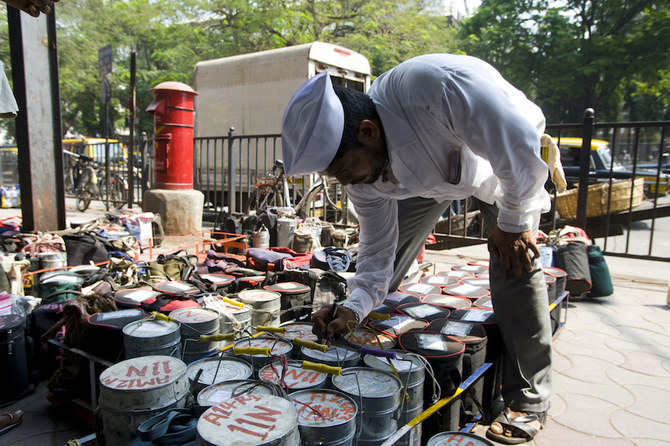
2. Their “Human” ERP: Coding, Standardization, and Cross-Docking
- Ingenious Colour Coding: Simple markings on each dabba convey all necessary information: destination neighbourhood, delivery person, building, floor, and station of origin—just enough for smooth flow without clutter.
- Power of Standardization: Efficiency is enhanced by standardized dabba sizes. Uniform lunchboxes pack quickly into standard crates for efficient loading, mirroring how ISO shipping containers revolutionized global logistics.
- Makeshift Cross-Docking Hubs: Railway stations function as temporary cross-docks where crates are sorted and handed over, eliminating warehouses and enabling rapid transfer.
- JIT (Just in Time): The process is designed to eliminate wait times. Minimal 'stock' (lunchboxes) builds up anywhere; everything is constantly in motion.
3. The Human Network: Decentralization, Discipline, and Resilience
- Non‑Centralized Control: Organized into ~200 autonomous units of roughly 25 people, local groups manage their own hiring, customers, and conflict resolution.
- Incredible Discipline and Accuracy: Train timetables set a relentless pace, with workers having as little as 20-40 seconds for transfers. Strict rule adherence is non‑negotiable, resulting in legendary accuracy.
- Built‑in Resilience: Each group maintains two or three cross‑trained extra workers as buffer capacity, enabling rapid recovery from disruptions and preventing small delays from escalating.
4. Other Remarkable Aspects
- Entrepreneurial Ownership: Each dabbawala is an equity partner, driving extreme accountability. New hires train for six months before they can buy into the business.
- Community as a Management System: A homogeneous workforce with a clear identity builds trust and reduces errors.
- Human Customer Relationship Management (CRM) : Afternoons are used to collect fees and handle customer issues, embedding relationship management into the daily workflow.
- Tiered Governance and Troubleshooting Structure: Experienced supervisors (muqaddams) troubleshoot locally, while elected committees handle broader issues.
- Resistance to Unproductive Complexity eliminating waste (Muda, Mura, Mudi): They maintain a laser focus on on‑time delivery, declining disruptive add‑ons (like flyer insertions) that threaten the core service.
Conclusion: Lessons from a Legacy
- The dabbawala system, with its 100+ year legacy, proves that with the right system, ordinary workers can achieve extraordinary results. It demonstrates that deep institutional knowledge, a decentralized human network, and an unwavering focus on a simple mission can outperform complex, tech-heavy solutions. For modern supply chain managers, the dabbawalas are a powerful reminder that the most effective systems are often those that are simple, robust, and built around the people who run them.