Agentic AI in Supply Chain Management: A Beginner's Guide
07-Jul-2026 — SCM4ALL Team
Agentic AI in Supply Chain Management: A Beginner's Guide is a practical supply chain topic that helps readers understand the core concepts, business implications, and real-world applications behind modern operations.
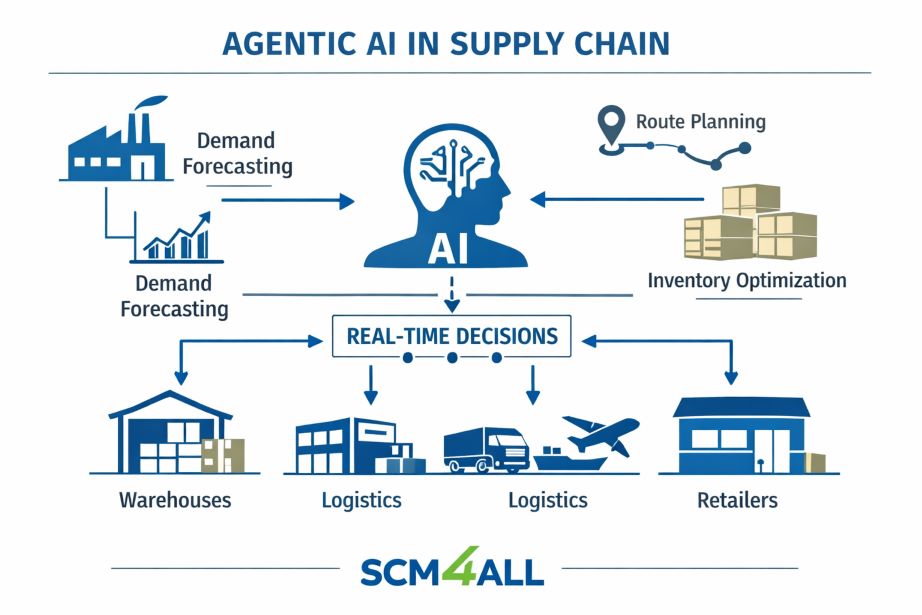
For decades, supply chains have relied on Enterprise Resource Planning systems to record transactions and manage operations. Later came Advanced Planning Systems, Business Intelligence dashboards, and Machine Learning models that improved forecasting and planning accuracy. More recently, Generative AI has shown impressive capabilities in summarizing information, answering questions, and assisting users with decision-making.
Despite these advances, many critical supply chain decisions remain highly manual. Supply planners still adjust supplier lead times based on experience, warehouse managers monitor bottlenecks through reports, procurement teams chase delayed purchase orders, and customer service representatives manually update customers about shipment delays.
For a broader view of related supply chain topics, explore our blog archive and return to this guide whenever you want a refresher on how Agentic AI is changing planning and execution.
The challenge is no longer the lack of data. Modern supply chains generate enormous volumes of information every second through ERP transactions, IoT sensors, warehouse systems, transportation platforms, supplier portals, and external market intelligence. The real challenge lies in transforming this continuous stream of information into timely decisions and actions.
This is where Agentic AI represents the next major evolution in Supply Chain Management.
Key idea: Unlike traditional AI systems that generate predictions or dashboards for humans to interpret, Agentic AI continuously observes business conditions, reasons about changing situations, recommends actions, and in many cases executes those actions within predefined business rules.
What is Agentic AI?
Artificial Intelligence has evolved through several distinct phases.
Traditional automation follows predefined rules. If inventory falls below a reorder point, the system generates a purchase requisition. Every step is explicitly programmed.
Machine Learning introduced predictive capabilities by identifying patterns in historical data. Forecasting demand, predicting equipment failures, or estimating transportation delays became possible without manually coding every scenario.
Generative AI further expanded capabilities by producing human-like text, images, software code, and conversational responses.
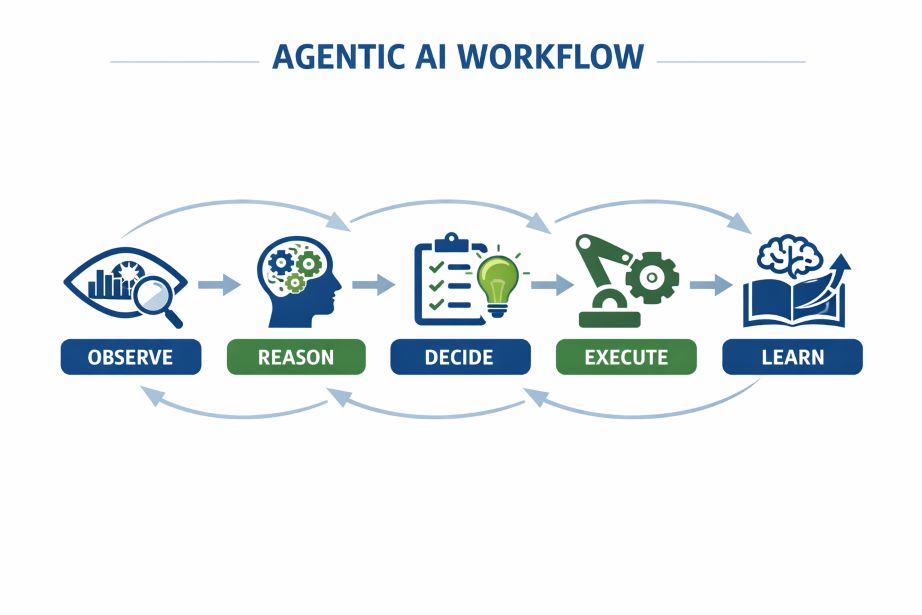
Agentic AI moves beyond all of these. Rather than simply answering questions or making predictions, an AI agent continuously performs work toward achieving a business objective. It observes its environment, reasons about current conditions, decides on an appropriate action, executes that action when permitted, evaluates the outcome, and learns from new information.
A typical Agentic AI workflow consists of six continuous stages:
- Observe business events and operational data
- Understand the current situation
- Reason about possible actions
- Decide on the optimal course of action
- Execute approved actions
- Learn from outcomes and continuously improve
Why Traditional ERP Systems Need Agentic AI
Modern ERP platforms such as SAP S/4HANA, Oracle Fusion Cloud, Microsoft Dynamics 365, Infor CloudSuite, Epicor, and NetSuite serve as the operational backbone of most organizations.
They excel at processing transactions, maintaining master data, recording inventory movements, managing purchase orders, and supporting financial reporting. However, ERP systems fundamentally depend on assumptions stored in their master data.
Supplier lead time may be configured as 28 days. Warehouse receiving time may be configured as four hours. Production cycle time may assume eight hours. Safety stock may have been calculated six months ago. Customer transit time may still reflect last year’s transportation network.
The ERP system faithfully executes planning calculations using these values, regardless of whether they still reflect operational reality.
Business conditions change constantly. Suppliers experience labor shortages. Ports become congested. Transportation routes change. Warehouse staffing fluctuates. Customer ordering patterns evolve. Weather disrupts logistics.
Continuous Master Data Optimization
One of the most promising applications of Agentic AI is the continuous optimization of master data.
Traditionally, planning parameters such as supplier lead times, warehouse processing times, safety stock levels, reorder points, and transportation transit times are reviewed periodically by planners. These reviews often occur quarterly or annually because they require significant manual effort.
Agentic AI changes this process completely. Instead of treating master data as static, AI agents continuously compare planned values against actual operational performance.
For example, an ERP system may indicate that Supplier A has a lead time of 28 days. However, after analyzing previous months of purchase orders, goods receipts, shipping records, customs data, and external logistics information, the AI agent determines that the actual average lead time has gradually increased to 35 days.
Rather than waiting for the next master data review, the AI recommends updating the planning parameter immediately. The recommendation may include supporting evidence such as:
- Historical average lead time
- Recent lead time trend
- Confidence level
- Predicted lead time for the next eight weeks
- Expected inventory impact
- Risk of future stock-outs
The planner can approve the recommendation, after which the ERP master data is updated automatically. As conditions improve, the AI may later recommend reducing the lead time again.
Bottom line: Master data becomes dynamic rather than static, allowing planning systems to reflect actual business conditions far more accurately.
Why this matters
Agentic AI does not replace planners, but it changes their role from reactive correction to proactive oversight. Instead of spending time gathering data and manually checking whether assumptions are still valid, planners can focus on exceptions, approvals, and strategic decisions.
In the next phase of supply chain transformation, the most successful organizations will be those that combine human judgment with AI agents that can continuously monitor, reason, and act within approved guardrails.