Supply Chain Visibility 101 - A primer
14-Nov-2025 - SCM4ALL Team
Supply Chain Visibility - A primer is a practical supply chain topic that helps readers understand the core concepts, business implications, and real-world applications behind modern operations.
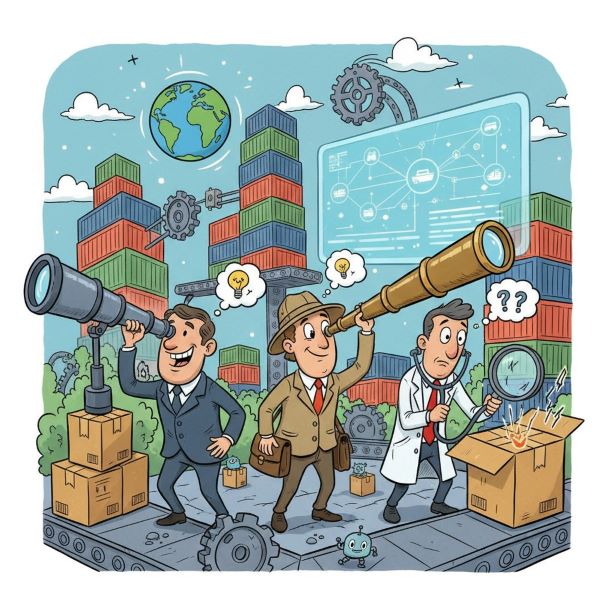
Imagine you're trying to bake a cake for a major event, but you have no idea if the flour has left the factory, if the eggs are still refrigerated, or if the delivery truck is stuck in traffic. That stress is what businesses face every day when they lack Supply Chain Visibility (SCV).
SCV is more than just tracking a package; it’s the ability to know the exact location, status, and condition of every product, component, and piece of information from the raw material supplier to the final customer. In today's complex global economy, visibility isn't a nice-to-have—it's the backbone of a resilient and profitable business.
🧐 What Makes for Good Visibility?
Good visibility is about getting the right information to the right person at the right time so they can take the right action.
| Feature | Description | Real-World Example |
|---|---|---|
| End-to-End View | Knowing what's happening at every tier: your supplier, your supplier's supplier, the shipping company, and the warehouse. | Failure Example: The 2013 Rana Plaza factory collapse highlighted how brands often had zero visibility beyond their direct (Tier 1) suppliers, leaving them unaware of dangerous working conditions deeper in their supply chain. |
| Real-Time & Predictive | Getting immediate data, and using that data to predict the future. | A logistics company doesn't just show a truck's current location; it uses traffic and weather data to predict an accurate delay for the next 48 hours. |
| Condition Monitoring | Tracking the environment and handling of the goods, not just the location. | A pharmaceutical company uses IoT sensors on a shipment of vaccines to monitor temperature and instantly alert a manager if the temperature rises above the safe threshold of 4 Deg Centigrade. |
🛠️ The Powerhouse: How ERP Systems Create Visibility
Think of a modern Enterprise Resource Planning (ERP) system as the central nervous system of a company. Before ERPs, different departments—like accounting, sales, and inventory—all had their own separate software. This created data silos (information trapped in one area).
A modern ERP system eliminates these silos by:
- Centralizing Data: Every transaction, from a customer order to a raw material delivery, is recorded in one place. When the Sales team checks the Inventory module, they see the exact same real-time stock count the Warehouse team is seeing.
- Integrating Processes: It forces departments to follow the same digital workflow. When a customer order is placed, the ERP automatically checks stock, creates a pick list for the warehouse, and generates the invoice. This seamless flow is visibility in action.
Real-World Case: Back in 1999, Hershey's famously had a massive system implementation failure right before their peak Halloween season. A lack of integration between their new systems meant orders weren't correctly communicating with inventory, preventing them from fulfilling about $100 million in sales. A modern, properly integrated ERP system is designed to prevent this exact type of communication breakdown.
🛑 The Hidden Pitfalls: Risks of Over-Reliance
Visibility is powerful, but relying too much on the data without proper strategy can introduce risks:
- Information Overload & Alert Fatigue: Receiving thousands of status updates per day can overwhelm human staff, leading to alert fatigue. Teams may start ignoring minor (but important) warnings, making them blind to a critical issue when it finally appears.
- The Agility Trap: Knowing about a problem doesn't solve it. If a company can see a major port is congested but doesn't have backup suppliers or alternative shipping contracts (agility), the visibility is simply a stressful confirmation of a disaster.
- Cybersecurity Risks: The more partners you connect digitally for greater visibility, the larger your digital attack surface becomes. A breach in a small, less-secure supplier's system can become a gateway for hackers to attack your main system and steal customer or operational data—a key risk in today's digital world.
🔮 The Crystal Ball: How AI Revolutionizes Visibility
Artificial Intelligence (AI) is transforming SCV from a "rear-view mirror" (showing what happened) into a "crystal ball" (predicting what will happen).
- Predictive ETAs (Estimated Times of Arrival): A simple GPS gives a rough ETA. AI ingests data from dozens of sources—historical transit times, weather patterns, live traffic reports, and even port schedules—to calculate a far more accurate and dynamic ETA. If a blizzard is predicted, the AI automatically bumps the ETA back and alerts the customer and logistics manager.
- Anomaly Detection: AI learns the "normal" behavior of your supply chain. If a shipment usually takes 7 days but is suddenly stuck at a particular customs checkpoint for 48 hours, the AI immediately flags this anomaly as high-risk, long before a human would spot it on a spreadsheet.
- Digital Twins: AI can help create a Digital Twin—a live, virtual replica of your entire physical supply chain. Companies can then run virtual "What-If" scenarios (e.g., "What if our main factory is shut down for two weeks?") and the twin instantly calculates the impact on inventory, costs, and customer orders, helping managers prepare a plan proactively.
🚀 Building the Future SCM Tool: Action, Not Just Sight
If we were to design the SCM tool of the future, it would be centered on Autonomous Action and Resilience:
- Autonomous Resolution Agents: When the AI predicts a problem (e.g., a supplier’s truck breaking down), the system wouldn't just send an alert. It would be empowered to automatically execute a pre-approved contingency plan, such as:
- Booking a faster, albeit more expensive, backup carrier.
- Splitting the order and shipping part of it from a different warehouse.
- Generating and sending a proactive delay notice to the impacted customers.
- Integrated Sustainability Ledger: Every movement of goods would be immediately associated with a live CO2 emission score. The tool would not only optimize for the lowest cost and fastest time but also for the lowest carbon footprint, helping businesses meet their environmental goals.
- Cross-Company Financial Health Dashboards: The system would constantly monitor the financial health and credit ratings of Tier 1 and Tier 2 suppliers. It would send an early warning if a critical supplier showed signs of financial distress, allowing the procurement team to secure an alternative source weeks or months before a potential bankruptcy shut down their production.
The SCM future is one where the system does the seeing and the acting, freeing up human professionals to focus on strategy, innovation, and managing relationships.